I build the internal automation rails that empower small B2B SaaS teams to operate like giants. Wire your forms, CRM, billing, and support tools together so leads, invoices, and tickets move automatically.
Most of my clients run on HubSpot or Pipedrive, charge via Stripe, and talk to customers in Slack or Intercom.
Not ready to book yet? See how the $2,500 sprint works
This is for small B2B SaaS teams with real customers and revenue, where founders or RevOps are still gluing ops together by hand.
What We Build (Example)
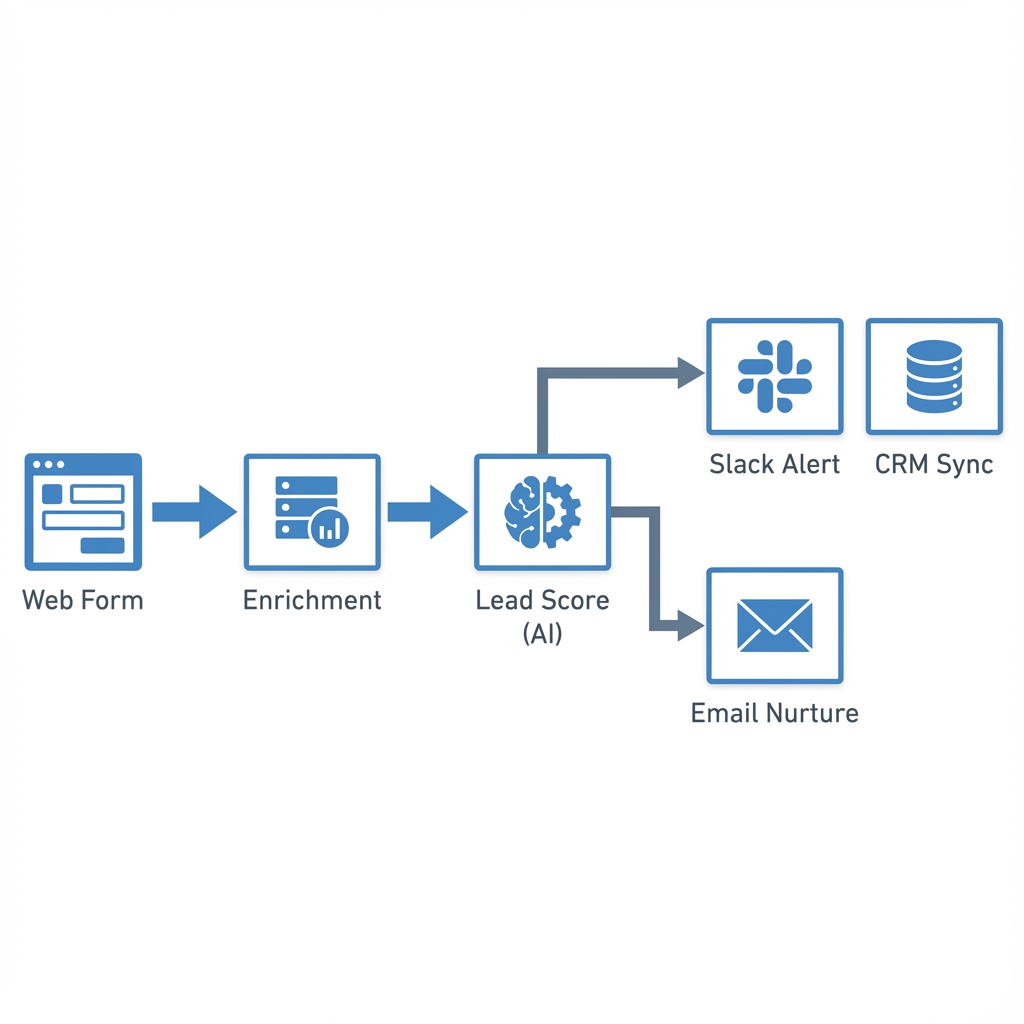
The "Lead Rescue" Protocol (CESRL)
Result: Every qualified lead is enriched, scored, and in front of the right human in under 5 minutes without anyone touching a spreadsheet.
Tech Note: Under the hood, this usually lives as a mix of CRM workflows (for simple rules) and a small Node/TypeScript service for scoring, enrichment, and logging.
Free 30-min call to map your workflows and see if a 7-day sprint makes sense for your team.
Concrete workflows that remove repetitive ops from your week so your team can focus on product and customers.
Pick the one that hurts most and mention it in your review form.
Tools: Webflow → HubSpot/Pipedrive → Slack.
Manual Work Removed: Copy-pasting form requests, manually assigning reps.
Result: Reps see "New P1 lead" in Slack with company size, tech stack, and a
pre-filled CRM record.
Tools: Zoom → HubSpot → QuickBooks/Xero.
Manual Work Removed: Drafting PDFs from scratch after every call.
Result: Zoom call credits → CRM Deal → PDF proposal drafted in Xero for
approval.
Tools: Intercom/Help Scout → Slack → Linear/Jira.
Manual Work Removed: Reading every generic support ticket to find bugs.
Result: AI tags "Bug" → Jira Ticket created → #engineering alerted, so
engineers only see clean, actionable tickets.
Most small SaaS teams are quietly burning mid five figures a year on manual ops they never budgeted for; here’s how the math usually looks.
Formula Basis
Calculation applies a standard 1.3x Labor Burden multiplier to account for payroll taxes, benefits, and insurance.
Annual P&L Impact
Recurring annually without intervention.
A single $2,500 sprint that kills one of these workflows pays for itself within months.
Powered by Enterprise Infrastructure
Think: HubSpot + Stripe + Intercom wired together via n8n and a small service, with your CRM as the source of truth.
All three options below deliver the same outcome—fast, reliable routing of leads and tickets; the only difference is where the logic lives.
We use your CRM’s own automation engine (HubSpot workflows, Pipedrive automations) to handle most of the logic. Good for simple rules that marketing/RevOps can tweak.
We write small Python/JS scripts inside HubSpot Ops Hub or Zapier Code steps. Good when you want enrichment and normalization without introducing new infra.
We deploy a lightweight Node.js API to handle complex routing. Best for teams that care about Git history, code review, and treating automation like real product code.
No retainers. No "hourly estimates". Just shipped code.
"Is this going to break my business?" No. I build with safety first.
I don't ship "happy path" code. Every automation has deep error catching that alerts me (and you) instantly if something fails.
Least-privilege access. I only touch the specific data needed for the workflow. No training public models on your customer data.
Critical actions (like sending contracts) can be set to "Draft Mode" first. You approve before the AI hits send.
I’ll look at your current tools (forms, CRM, email, Slack), then build a small, reliable system that makes sure good leads are automatically enriched, prioritized, and put in front of the right person in under 5 minutes. I usually do it with a mix of your CRM’s own workflows (like HubSpot workflows and Ops Hub custom code actions) and a small service I write for you, so everything runs inside your stack and is documented for your team.
I specialize in small B2B SaaS because you have high-value leads and messy manual processes—the perfect target for high-ROI automation. My philosophy is simple:
The Quick Start Sprint process.
We map the exact workflow steps. You grant access to necessary tools (HubSpot, Stripe, etc). I set up the secure environment.
I connect APIs, build the logic, and test edge cases. You get daily video updates showing the actual bot doing work.
I walk you through the working system via Zoom. We run test data together. You approve the deployment.
System goes live. You get a Loom training video and a simplified "How To" doc for your team.
You want results in days, not months. You don't need a year-long roadmap.
You have a specific manual task (e.g. "Copy data from email to Excel") that you hate.
You can approve a $2,500 sprint without 3 months of procurement red tape.
Deep dives on automation architecture. These are the same patterns we implement in 7‑day sprints for clients.
The technical "break-even" point where no-code tools become technical debt. A guide for CTOs.
Why we moved from "All-in-One" to Modular: HubSpot + n8n + Supabase + OpenAI.
Building a "Smart Inbox" that drafts replies and routes tickets based on sentiment.
Straight answers for technical leaders.
The Quick Start Sprint is delivered in strictly 7 days from the kickoff call. We scope the work specifically to fit this timeline comfortably.
No. We write custom code (Node.js, Python, Next.js). While we use tools like n8n for orchestration, the core logic is often hard-coded for reliability, security, and version control.
If your team lives in HubSpot or Pipedrive, charges customers via Stripe, and talks in Slack or Intercom, you’re exactly who this is for. We also support Help Scout, Zendesk, Close, and Xero.
Yes. We integrate with any API-enabled tool. Common stacks include Pipedrive, Close, HubSpot, Salesforce, Stripe, Xero, Intercom, Help Scout, Zendesk, Slack, Make/Zapier, and n8n.
You own the code and IP 100%. We offer a 2-week support window for adjustments, and optional monthly retainers for ongoing optimization.